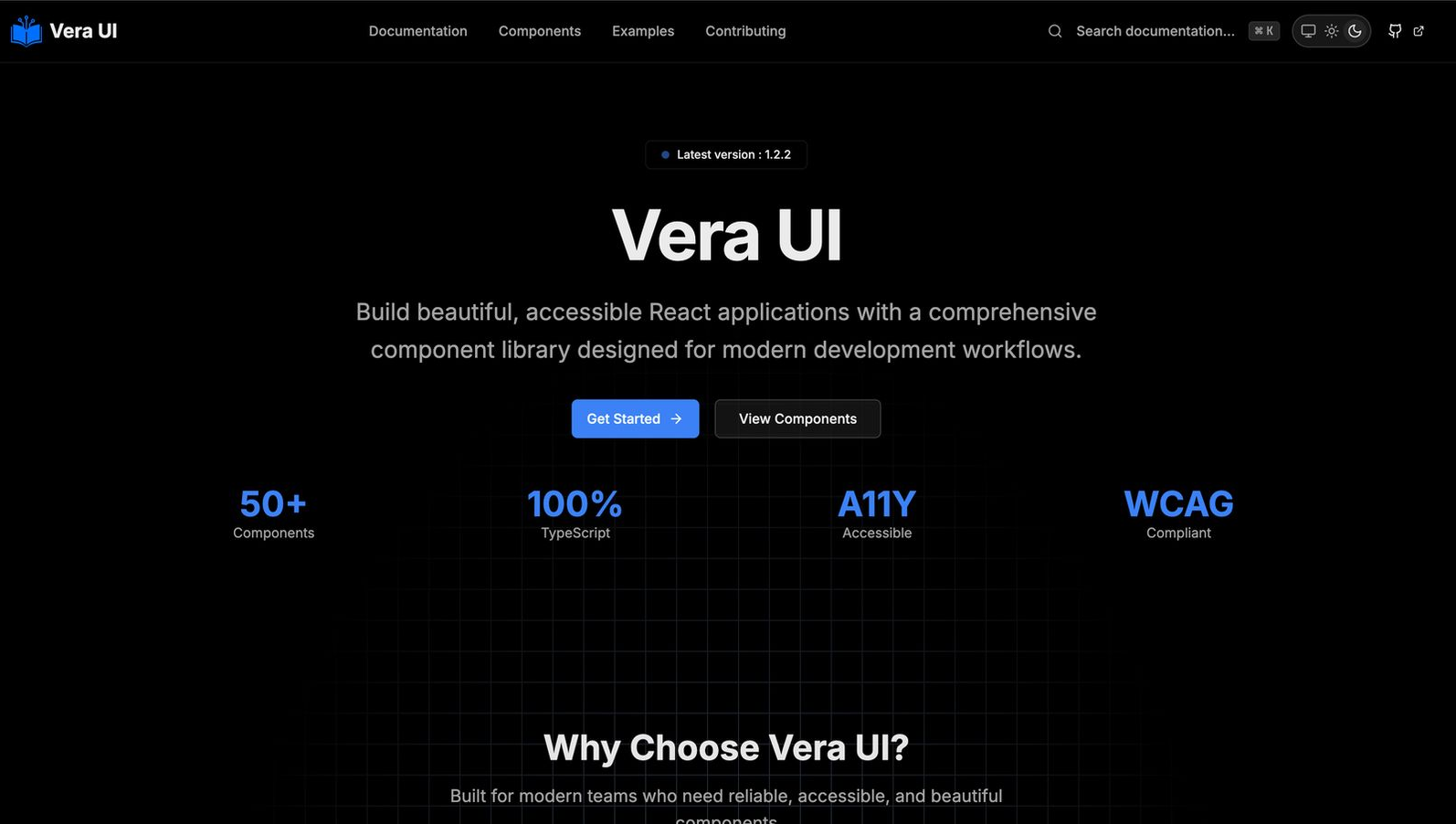
VeraUI — Open-Source React Component Library
Contributed to VeraUI’s DataTable, sidebar components, and documentation, helping developers build configurable data interfaces and application navigation.
- The problem
- Data tables and application sidebars involve recurring complexity. Developers need sorting, filtering, selection, navigation groups, active-route indicators, and responsive layouts, often with different styling and state requirements. A component library needs to package these behaviors into reusable APIs while providing documentation that makes configuration and integration clear.
- My role
- Open-source frontend contributor, focused on React component development, component refinements, and technical documentation within an existing shared library.
- My contribution
- DataTable contributions: Improvements to a reusable table component supporting sorting, filtering, row selection, expansion, custom rendering, and row actions. Sidebar contributions: Improvements to reusable navigation components supporting active routes, grouped navigation, configurable styling, and application layouts. Documentation contributions: Component guides, API explanations, and examples that help developers integrate and customize the library.
- The approach
- Contribute configurable table and sidebar components backed by reusable UI primitives, typed interfaces, and practical documentation. The DataTable exposes options for data interactions and custom rendering. The sidebar supports configurable navigation structures, route-aware styling, and shared layout state. Documentation brings these capabilities together through usage examples and API references.
- Reusable React component development with TypeScript
- DataTable interaction and presentation improvements
- Configurable table columns and custom rendering
- Row selection state and visual feedback
Overview
VeraUI is an open-source React component library built with TypeScript, Radix UI primitives, and Tailwind CSS. It provides reusable components for building consistent application interfaces. My contributions focused on the DataTable, sidebar components, and library documentation. I helped improve components used for displaying and interacting with data, organizing navigation, and composing application layouts. I also contributed documentation that explains component APIs, customization options, and integration patterns. The work combined frontend engineering with developer experience: making reusable components easier to adapt and helping developers understand how to use them.
Configurable table APIs for different data shapes
A shared table component must accommodate different records and presentation requirements. My contribution sat within a generic TypeScript API that connects column names to the supplied data shape and exposes callbacks for custom headers, cells, and row actions. This approach lets applications reuse table behavior while supplying their own presentation and business logic. The tradeoff is a larger configuration surface. Column keys are constrained by the record type, although some internal operations still use any.
Supporting evidenceConsistent selection feedback in interactive tables
Selection needs to remain understandable alongside filtering, row expansion, and row actions. The component keeps selection in application-controlled row IDs and calculates bulk-selection state from the currently filtered rows. The implementation also exposes selected state through data-state and aria-selected, separating selection state from a hardcoded background color. This provides hooks for visual feedback and accessibility semantics. Applications should supply stable row IDs when records can change order, because the default identity uses array indexes.
Supporting evidenceKeeping grouped navigation aligned with the active route
Grouped navigation must balance a user’s preferred expanded sections with visibility of the current page. The sidebar stores group open states in localStorage and uses route matching to identify active navigation items. A group containing the active route remains open so the current location stays visible. The tradeoff is that the active group can override a saved closed preference. Persistence also uses a shared storage key, which can require additional namespacing when an application contains multiple independent sidebars.
Supporting evidenceComposing navigation from provider, sidebar, and layout components
Navigation content, responsive behavior, and page layout have different responsibilities. The implementation separates them: SidebarProvider manages shared state and theme configuration, ReusableSidebar renders navigation, and SidebarLayout composes the sidebar with a trigger and application content. This structure supports both standalone navigation and a ready-made application layout. The tradeoff is integration setup: the reusable sidebar requires provider context and uses React Router hooks, so consumers need the appropriate router context.
Supporting evidenceDocumentation that connects APIs with usage examples
Flexible components need examples that explain how their options work together. My documentation contributions helped make the library’s APIs and integration patterns easier to understand. The documentation system pairs MDX guides with React examples and preview/code views. Its build process can extract example functions into generated code snippets, reducing duplicated examples. This helps maintenance, although extracting a function does not automatically include every external variable or helper it depends on.
Supporting evidenceTraceable implementation and usage evidence
The contribution areas can be inspected through component source, documentation, examples, and repository history. The examples demonstrate table sorting, searching, selection, actions, and expansion, alongside basic, grouped, mixed, and styled sidebar configurations. For this portfolio draft, verification consisted of reviewing that material and comparing documentation claims with the implementation. Automated tests, browser behavior, performance results, and accessibility compliance were not established by this review.
Supporting evidenceClient-side table processing and application integration
The reviewed DataTable filters and sorts the supplied records in the browser. It does not implement built-in pagination or row virtualization, despite pagination appearing in the documentation description. Applications handling large datasets would need additional data-loading and rendering strategies. The manualSort option changes the sorting controls; it does not disable local sorting. These boundaries define the component’s demonstrated scope without implying server-side data handling or measured scalability.
Supporting evidence